
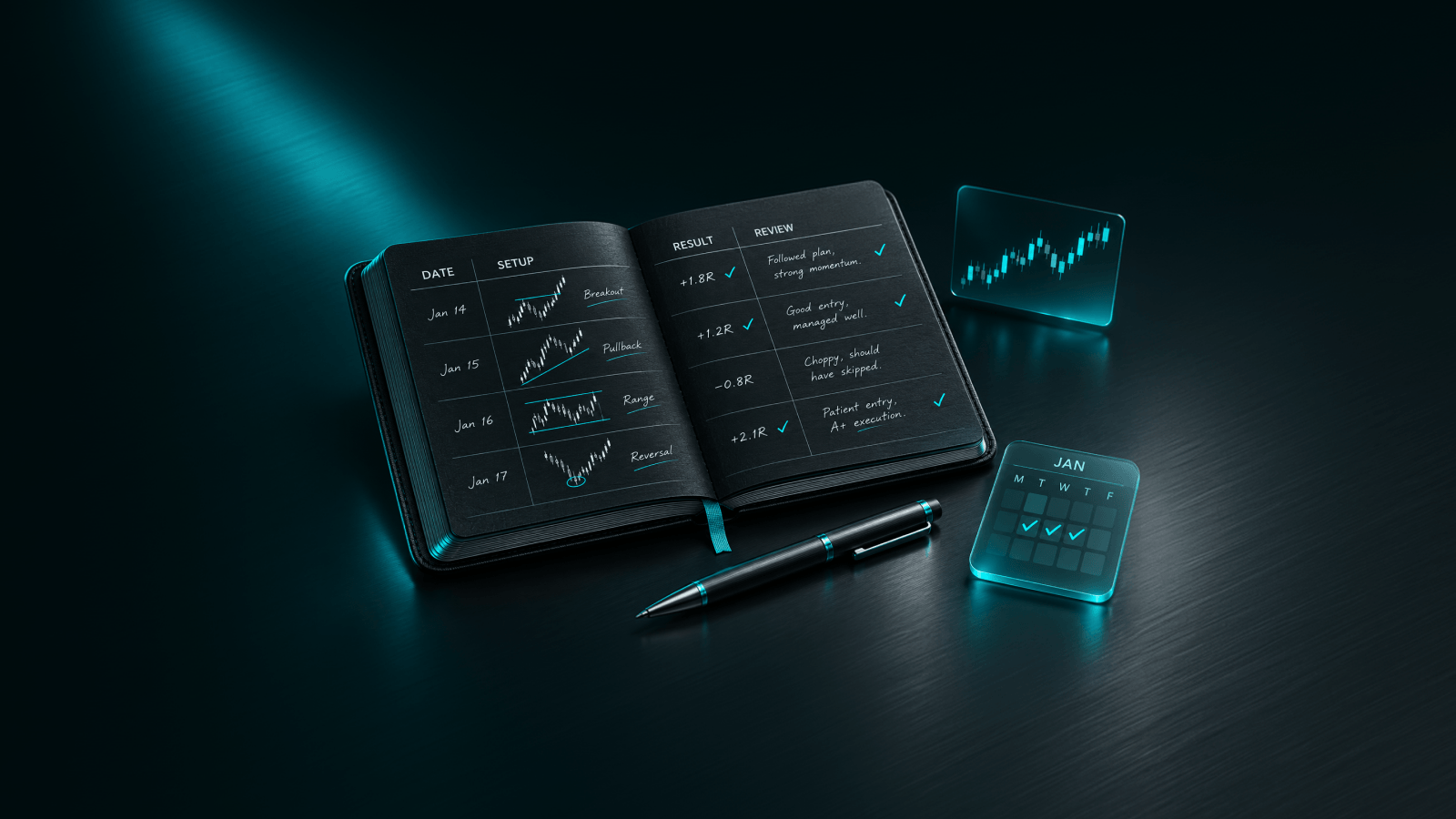
Most traders do not stop journaling because they think it is useless. They stop because the journal becomes work.
After every trade, they are expected to record the entry, exit, setup, market conditions, screenshot, risk, emotions, mistakes, lessons, and several performance figures. After a few sessions, the process becomes easy to postpone.
The trading journal you keep should be simple. Record information that helps you find answers to specific questions about your trading. Let your trading platform or analytics software automatically record the information it already knows, and then add context that the software itself cannot.
The goal is to make your trading decisions easier to review, not to create the longest possible record of every position.
What is a Trading Journal?
A trading journal is a record where traders document their trades, including entry and exit prices, trade size, strategy, profit or loss, and the reasons behind each trading decision.
A normal trade history can tell you that you bought EUR/USD, how large the position was, and where you exited.
A journal should help answer harder questions:
- Why did you enter?
- Was the setup part of your plan?
- Did you use the intended risk?
- Did you follow your exit rules?
- Does the same setup perform differently at certain times?
- Are losses coming from the strategy or from how you execute it?
That difference matters. A trade log records events. A useful journal connects those events to your trading process.
What Should You Record in a Trading Journal?
A practical trading journal should include three main types of information:
1. Trade Facts
Record the instrument, trade direction, entry and exit prices, position size, stop-loss, and final result. This helps you track what happened in each trade.
2. Strategy Context
Note the trading setup, timeframe, trading session, and reason for entering the trade. These details help you compare similar trades and understand how your strategy performs.
3. Process Review
Record whether you followed your trading rules, any mistakes made, and a short review of the trade. This helps you identify whether problems come from your strategy or how you execute trades.
How Do You Keep a Trading Journal Consistently?
Make the journal easy enough to complete after an ordinary trade and after a frustrating one.
That second part matters because traders often journal carefully when trading is going well and stop recording when results become uncomfortable.
A few rules can make the habit easier to maintain.
1. Keep Your Required Fields Short
Do not make 20 fields mandatory.
Start with:
- Setup
- Risk
- Result
- Rules followed: yes or no
- One short note
Add more fields only when you know what question they will help answer. If you never review a field, stop recording it.
2. Record the Setup Before You Know the Result
A losing setup can suddenly appear obviously poor after the loss. A winning trade can look smarter than it actually was. Record the setup name and entry reason before or shortly after entry.
After the trade closes, add the result and review notes separately. That gives you a cleaner comparison between your original decision and what happened later.
3. Use Consistent Tags
Avoid describing the same setup five different ways.
If your strategy is called “breakout retest,” keep that tag consistent instead of switching between:
- breakout
- retest trade
- breakout setup
- BR
- resistance break
Consistent labels make later comparisons much easier. The same principle applies to mistake tags.
You might use labels such as:
- Late entry
- Oversized position
- Moved stop
- Early exit
- Off-plan trade
Keep the list small enough that you will actually use it.
How Often Should You Review Your Trading Journal?
Review individual trades briefly after they close, then run a broader review on a fixed schedule.
A weekly review works well for many active traders because it gives you enough recent trades to inspect without waiting until the end of a long period.
Focus the review on a few questions:
- Which setups did I trade?
- Which setups produced the strongest and weakest results?
- Where did I break my rules?
- Did risk stay within my plan?
- Did timing affect results?
- Is one mistake repeating?
Avoid changing your strategy after every losing session. Look for repeated behaviour before making changes.
What Should Multi-Account Traders Journal?
Multi-account traders have a problem that basic journal templates rarely address. If the same trade is copied across eight accounts, recording eight identical journal entries creates unnecessary work.
A better structure separates the trading decision from the account execution.
Strategy-Level Record
Record the decision once:
- Setup
- Entry reason
- Market
- Direction
- Planned risk
- Strategy tag
- Rules followed
Account-Level Record
Then track only differences that matter on each account:
- Actual position size
- Execution difference
- Slippage
- Failed copy
- Risk-rule difference
- Account-specific result
This approach is especially useful for traders using trade copier software across personal, evaluation, or funded accounts.
One trading idea may be identical across the group while account balances, lot sizing, execution conditions, or risk limits differ. Your journal should preserve that distinction.
What Metrics Should You Review?
Profit and loss alone does not explain how you traded. Useful performance measures can include:
Win rate: How many trades finished as winners?
Average win and average loss: Are your winners large enough relative to losses?
Profit factor: How do total winning trades compare with total losing trades?
Drawdown: How much did account equity decline during weaker periods?
Results by setup: Which strategies are producing different outcomes?
Results by time: Do certain sessions or trading hours behave differently?
Traders Connect Analyzer presents metrics including portfolio ROI, win rate versus loss rate, drawdown, time-of-day analysis, strategy or tag breakdowns, profit factor and multi-account analysis for connected accounts.
Common Trading Journal Mistakes
Recording Too Much
A journal that takes longer to complete than the trade itself will be difficult to maintain.
Remove fields you do not review.
Writing Only After Losses
If you document mistakes but ignore well-executed trades, your journal becomes biased toward problems.
Record both.
Treating Every Loss as a Mistake
A trade can lose while still following the strategy correctly.
Separate:
Bad outcome: The market moved against the position.
from:
Bad process: You ignored your trading rules.
That distinction helps you avoid changing a valid process simply because of short-term losses.
Tracking P&L Without Tracking Risk
Two trades can make the same amount of money while taking very different levels of risk.
Record enough risk information to make performance comparisons meaningful.
Never Reviewing the Journal
Recording trades without reviewing them turns the journal into storage.
The review is where patterns become useful.
Why Traders Struggle to Stay Consistent With a Trading Journal
Many traders stop maintaining a journal because the process becomes too complex.
Recording every trade manually, updating results, checking multiple accounts, comparing setups, calculating win rate, reviewing drawdown, and finding patterns across different sessions can turn journaling into another task that gets postponed.
The problem becomes even bigger for traders managing several accounts because the same trading idea may appear across multiple account histories.
This is where Traders Connect Analyzer can reduce part of that workload. It brings connected account data into one place and gives traders access to metrics such as portfolio ROI, win rate versus loss rate, drawdown, profit factor, time-of-day performance, strategy or tag breakdowns, and multi-account analysis.
Instead of manually calculating these numbers for every review, traders can use Analyzer for the data side of the process and keep their journal focused on the information software cannot fully capture, such as why a trade was taken, whether the trading plan was followed, and what could be improved.
Build a Journal You Can Keep Using
A trading journal is useful only if you continue using it and review what it tells you. Keep the process simple, record information that supports real trading decisions, and avoid filling the journal with fields you never analyse.
Trade data, performance metrics, and account history can help identify where results differ, while your own notes explain the decisions behind those numbers. For traders managing several accounts, Traders Connect Analyzer can make it easier by bringing key performance metrics and multi-account analysis into one place.
FAQs
Q1. What should a beginner put in a trading journal?
A. Start with the instrument, setup, entry reason, risk, result, whether you followed your rules, and one short lesson. Add fields later only when they help answer a real review question.
Q2. Should I journal every trade?
A. Yes, if you want the journal to represent your trading accurately. Selectively recording only large wins or losses can distort your review.
Q3. Can I use a spreadsheet as a trading journal?
A. Yes. A spreadsheet can work well if the format is easy to maintain and lets you sort or compare trades. Dedicated analytics tools can reduce manual data entry when you manage many trades or accounts.
Q4. How do I journal copied trades across multiple accounts?
A. Record the trading idea once, then track account-level differences separately. This avoids duplicating the same strategy note for every copied account while preserving execution and risk differences.
Q5. What should I look for during a journal review?
A. Look for repeated differences by setup, trading time, risk, instrument, account, and rule adherence. Focus on patterns across several trades rather than one result.